Swing Trading 101: Capturing the Meat of the Move
The trading style built for people with jobs, families, and no desire to stare at screens all day.
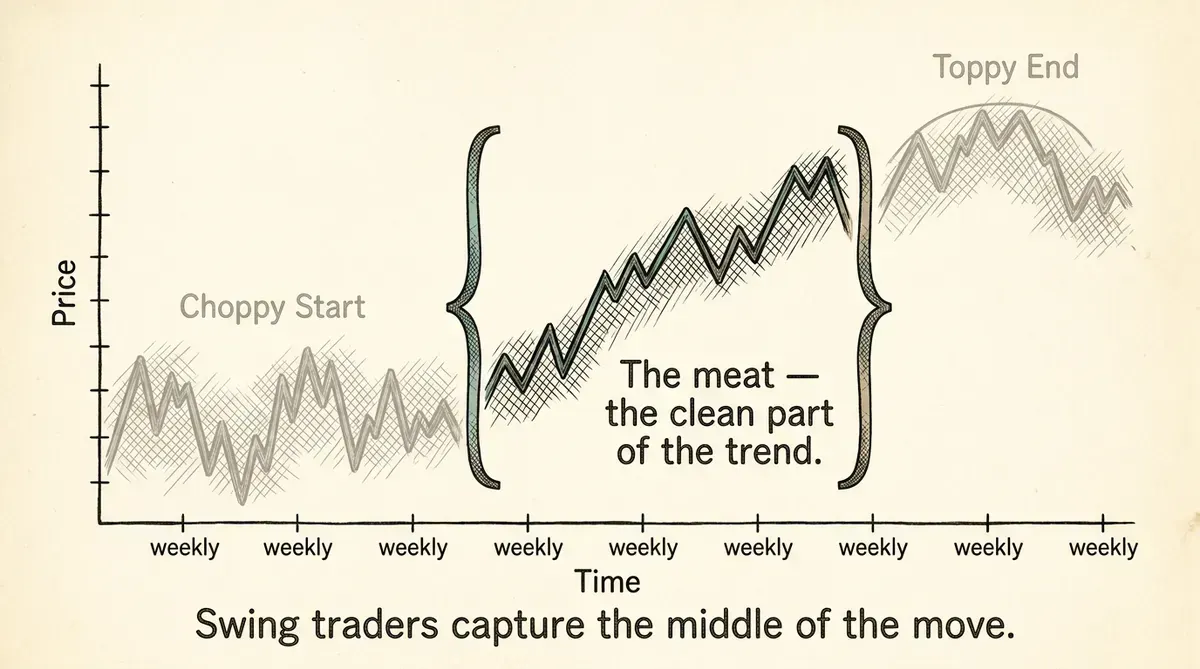
What swing trading actually is
Every stock move has three parts: a messy beginning nobody believes in, a clean middle where the trend is obvious, and a chaotic end where everyone finally piles in. Swing trading is the craft of owning the clean middle — entering after a move proves itself, exiting before it exhausts, holding for days to a few weeks.
That timeframe is not a compromise; it's a sweet spot:
- Slower than day trading, so you're not competing tick-by-tick against algorithms and professionals — a fight retail traders lose almost by definition. Day trading also demands your entire day; studies of retail day traders are grim reading.
- Faster than buy-and-hold, so capital recycles into fresh setups every few weeks, and you're never married to a position through earnings disasters and year-long droughts.
- Structured around defined holding periods. Swing-trading decisions can be assessed with a deliberate process rather than continuous monitoring. The relevant work is to identify a valid structure, define risk, and decide in advance how the position will be managed.
The only math you truly need: R
Before setups, before patterns, before anything — understand R, because it's the difference between trading and gambling.
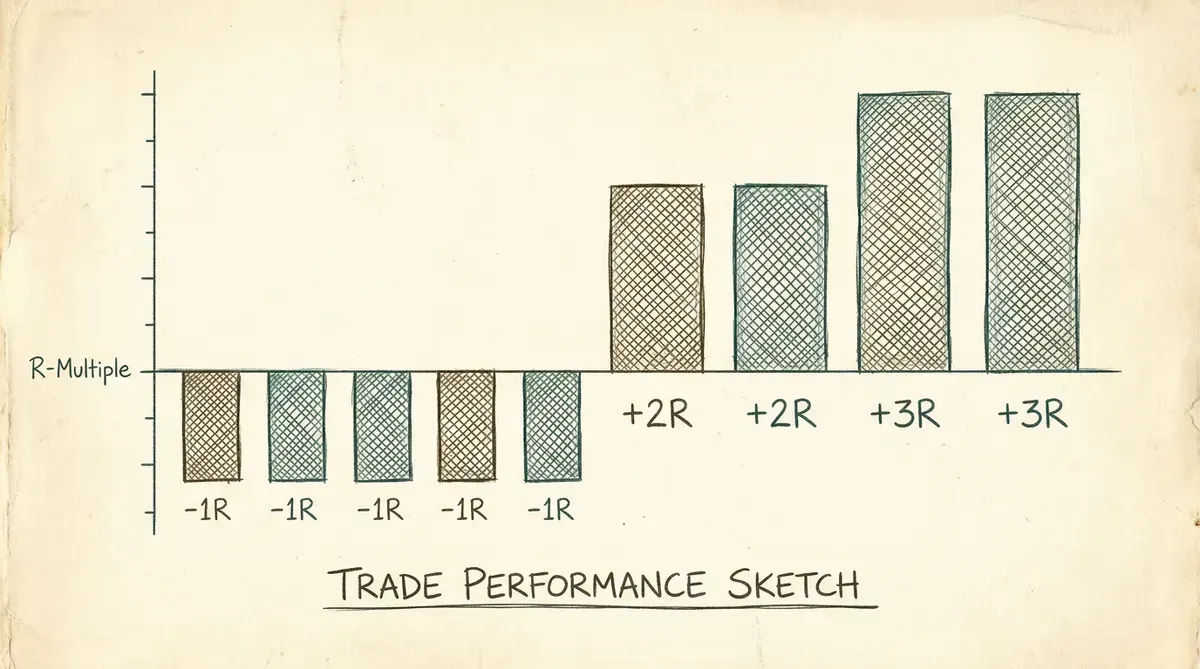
R is the amount you're willing to lose on one trade. Suppose you buy a stock at $50 with a stop-loss at $47.50: your risk is $2.50 per share. If you're willing to lose $200 on the idea, you buy 80 shares. That $200 is 1R. Everything about the trade is now measured in R: sell at $55 and you made +2R; stopped at $47.50, −1R.
Two rules turn R into survival:
- Risk a small fixed slice of your account per trade — commonly around 1%. At 1% risk, a losing streak of ten trades — which will happen to you — costs about 10% of your account. Annoying, recoverable, survivable. At 10% risk per trade, the same streak is ruin.
- Only take trades where the realistic reward is a multiple of the risk — 2R or better. This changes everything psychologically, because it means you can be wrong most of the time and still make money. Win 40% of your trades at an average +2.5R against −1R losses and you're solidly profitable. Swing trading is not a prediction contest; it's a payout-structure business.
Position sizing off your stop distance (not off gut feel) is the discipline that makes all of this real. Size = (account × 1%) ÷ (entry − stop). Write it down; it's the most valuable formula in trading.
What you trade: strength, structure, and a trigger
The highest-probability swing trades share three ingredients (each gets a deep dive in The Anatomy of a High-Probability Swing Setup):
- A trend at your back. Trade long in stocks in established uptrends — above their rising long-term moving averages, in strong sectors. Swimming with the current is the single biggest odds-booster available.
- A structure that defines risk. Pullbacks to support, tightening consolidations, channels — patterns whose shape tells you exactly where the trade is wrong, so the stop is logical, close, and honest.
- A trigger that confirms. An actual sign buyers have returned — a strong up day, a push through a level, expanding volume — so you're acting on evidence, not hope.
And one non-negotiable habit: check the earnings date before every entry. Earnings reports gap stocks past stops. Holding a routine swing trade into a report you didn't know about isn't unlucky — it's unprofessional.
The evening routine (the actual job)
Swing trading, done properly, is a repeating 20–30 minute evening loop:
- Market check. Is the overall market trending up, chopping, or falling? In hostile tape, the correct position size is often zero. The pros' secret isn't trading well in bad markets — it's barely trading in them.
- Scan for setups. Sweep the market for your patterns: pullbacks near support, coiled consolidations, fresh breakouts on volume.
- Plan in writing. For your best one to three candidates: entry, stop, target, size, earnings date. A trade that isn't written down isn't a plan; it's a mood.
- Manage what you hold. Winners: trail stops as the swing progresses. Losers: they hit the stop, they're gone. No negotiations, no "one more day."
- Journal. Two minutes: what you did and why. In three months, your journal will teach you which setups actually pay you — a personal edge no article can give you.
The practical challenge in this routine is step 2: reviewing a broad market universe for a small number of structures that meet defined criteria. Relaxfolio helps organise that review through queries such as "pullbacks", "upward channels", "breakout stocks", and "upcoming earnings". Saved screens can support regular review and email updates, while the investor remains responsible for selection, sizing, and execution.
The five habits that decide who survives
After the setups and the math, swing trading outcomes mostly reduce to behavior:
- The stop is sacred. Moving a stop down to avoid taking a loss is the beginning of the end.
- Boredom is not a setup. No qualifying pattern tonight? Then tonight you don't trade. The market pays for selectivity, not activity.
- Small size while learning. Your first fifty trades are tuition. Make the tuition cheap.
- One playbook at a time. Master a single setup — say, the uptrend pullback — before collecting others. Depth beats variety.
- Protect the downside; the upside handles itself. Every rule above is a form of this one.
Swing trading won't make you rich by Friday — anyone promising that is selling something. What it offers is better and real: a professional, risk-controlled way to compound capital on a schedule that fits an actual life, with a process you can improve every single week.
Next in this series: The Anatomy of a High-Probability Swing Setup and Volume Tells the Truth.
To review pullback candidates through a defined framework, ask Relaxfolio for "pullbacks". Explore Relaxfolio →
This article is for educational purposes only and is not investment advice. All investing involves risk, including possible loss of principal.
Put this into practice tonight
Ask Relaxfolio in plain English and get a researched answer in minutes.
Get started