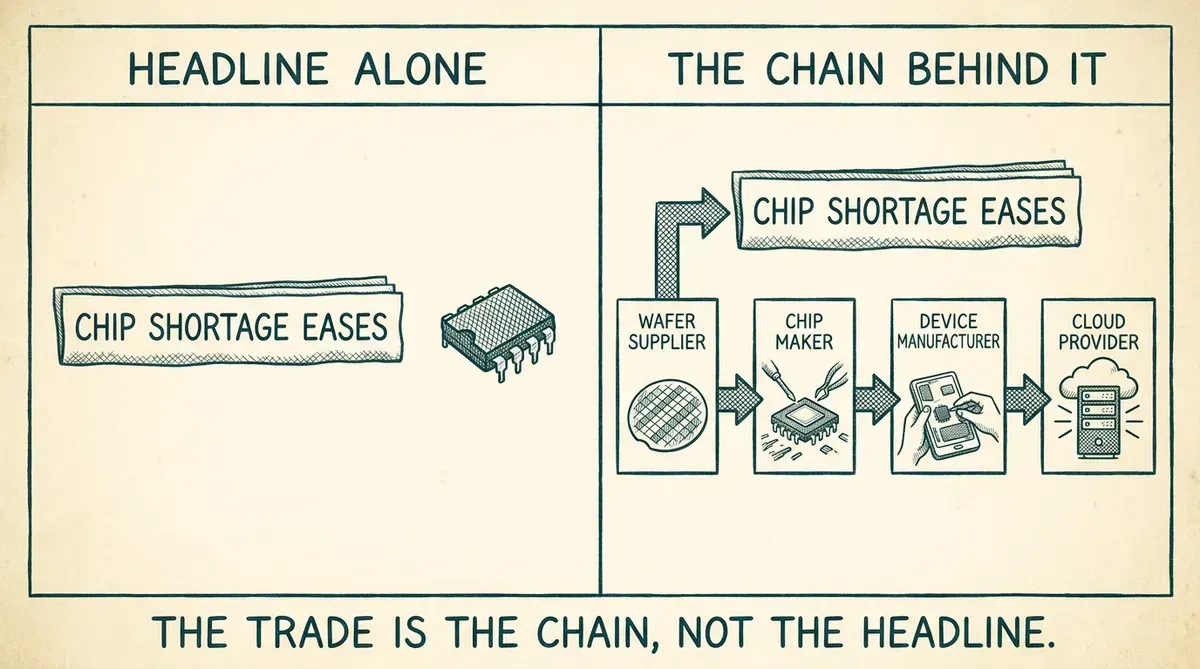
The trade is rarely the headline — it's the companies connected to it.
A policy shift, conflict, technology transition, or supply shock affects a chain of businesses across different industries. Relaxfolio lets you start with the story, map the related companies, and review price action, fundamentals, and participation in one research flow.
Narratives cross sectors. Most tools do not.
Thematic research begins with a force — a war, an election, a technology adoption curve, a tariff, a commodity squeeze — and ends with a set of companies that may benefit, suffer, or simply move together. Sector and industry screens split that chain apart. A defense budget increase, a power-grid buildout, and a rare-earth supply constraint each touch businesses in different classification boxes.
The work is not finding the headline. It is mapping which companies are actually exposed, how strongly, and whether the market is already pricing the story.
From narrative to a reviewable stock map.
Questions thematic investors ask.
From developing story to documented view.
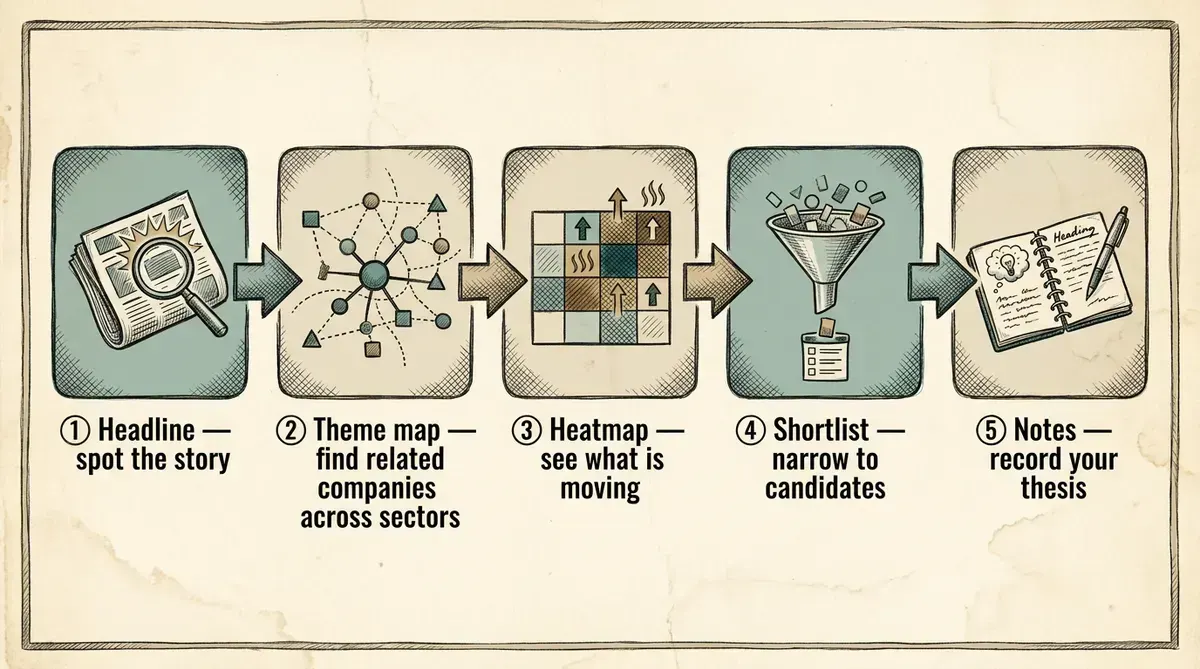
- 1 Identify the driver. Read market commentary or ask what themes are active — policy, conflict, technology, supply, or demand.
- 2 Map the exposure. Use theme heatmaps and grouped screens to see which companies sit in the relevant chain.
- 3 Test market pricing. Review price trends, relative strength, and breadth across the group — is the story isolated, early, or crowded?
- 4 Examine the candidates. Open the leaders, suppliers, and adjacent names for fundamentals and material developments.
- 5 Document the thesis. Save the screen and note what would confirm or invalidate the view.
Thematic investing guides.
Membership pricing
A research workflow for mapping narratives — macro, geopolitical, and technology-driven — to the US companies and ETFs most exposed to them.
$60
$600 · billed annually
See Terms of Service and Privacy Policy for membership terms.
Thematic investing questions
What is thematic investing? ▾
How is a theme different from a sector? ▾
Can Relaxfolio help with geopolitics-related research? ▾
What is a theme heatmap? ▾
How do you avoid buying a crowded theme? ▾
Can I track a theme over time? ▾
Map the story first. Then review the stocks.
Start with a narrative, see the companies it connects, and build your own view from the evidence.
Explore thematic research