Value Investing for Beginners: Buying Dollars for Fifty Cents
The oldest strategy in the book, explained from first principles — including the part beginners always get wrong.
One idea, endlessly misunderstood
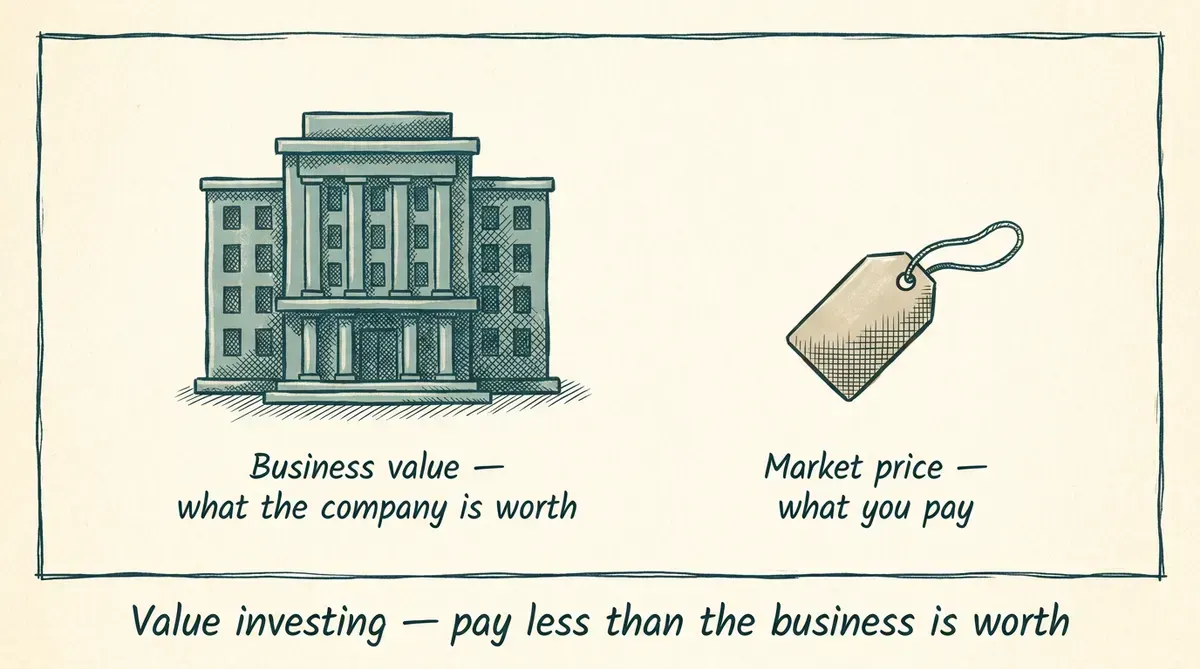
Value investing can be stated in a single sentence: a stock is a piece of a business, and sometimes the market sells that piece for less than it's worth. Buy those pieces, wait for the market to come to its senses, and the gap between price and value becomes your profit.
Warren Buffett built one of history's great fortunes on this idea, and it rests on a distinction most people never make: price is what the stock trades at today; value is what the underlying business is actually worth, based on the cash it will generate over its lifetime. Price is set minute-to-minute by mood, headlines, and forced sellers. Value changes slowly, with the business itself. The whole strategy lives in the space between the two.
The famous metaphor is Benjamin Graham's "Mr. Market": imagine a manic business partner who shows up daily offering to buy your shares or sell you his — at wildly different prices depending on his mood. You're free to ignore him for years, then transact only on the days his mood hands you a gift.
What makes a business worth owning at all
Beginners jump straight to "is it cheap?" That's the wrong first question. The right first question is: is this a good business? Because a mediocre business at a low price is usually just a mediocre outcome at a discount.
A few markers separate good businesses from the rest:
- A moat. Something that stops competitors from stealing its profits — a brand people pay extra for, switching costs that lock customers in, network effects, scale nobody can match, or patents. No moat means today's fat profits are tomorrow's competitor bait.
- High margins, consistently. Gross and operating margins that stay strong year after year are the financial fingerprint of a moat. Anyone can have one great year; only a protected business defends its margins for a decade.
- Real cash generation. Accounting earnings can be dressed up; cash is harder to fake. Free cash flow — money left after running and maintaining the business — is what ultimately pays for dividends, buybacks, and growth.
- A sane balance sheet. Debt is a magnifier: it makes good times better and bad times fatal. Low debt relative to equity means the business controls its own destiny, and can even go shopping when weaker rivals stumble.
- Owner-minded management. Watch what they do with cash: disciplined buybacks when the stock is cheap, sensible acquisitions or none, and ideally insiders buying shares with their own money.
Now — is it cheap?
Only after a business passes the quality test does valuation matter. The classic yardsticks, in plain English:
- P/E ratio — the price you pay for each dollar of annual earnings. A P/E of 15 means you pay $15 per $1 of yearly profit. Useful, but only in context: a P/E of 12 is expensive for a shrinking business and dirt cheap for a growing one.
- Free cash flow yield — annual free cash flow divided by the company's total price. Think of it as the "interest rate" the business earns you. A 7–8% FCF yield from a stable business compares very favorably to what bonds pay.
- P/B ratio — price against the company's net assets. Most useful for banks and asset-heavy businesses; less meaningful for software or brands.
- Buyback yield — the percentage of its own shares a company retires each year. A quality business steadily buying back stock is compounding your ownership stake without you lifting a finger — and management is signaling the shares are worth more than the market thinks.
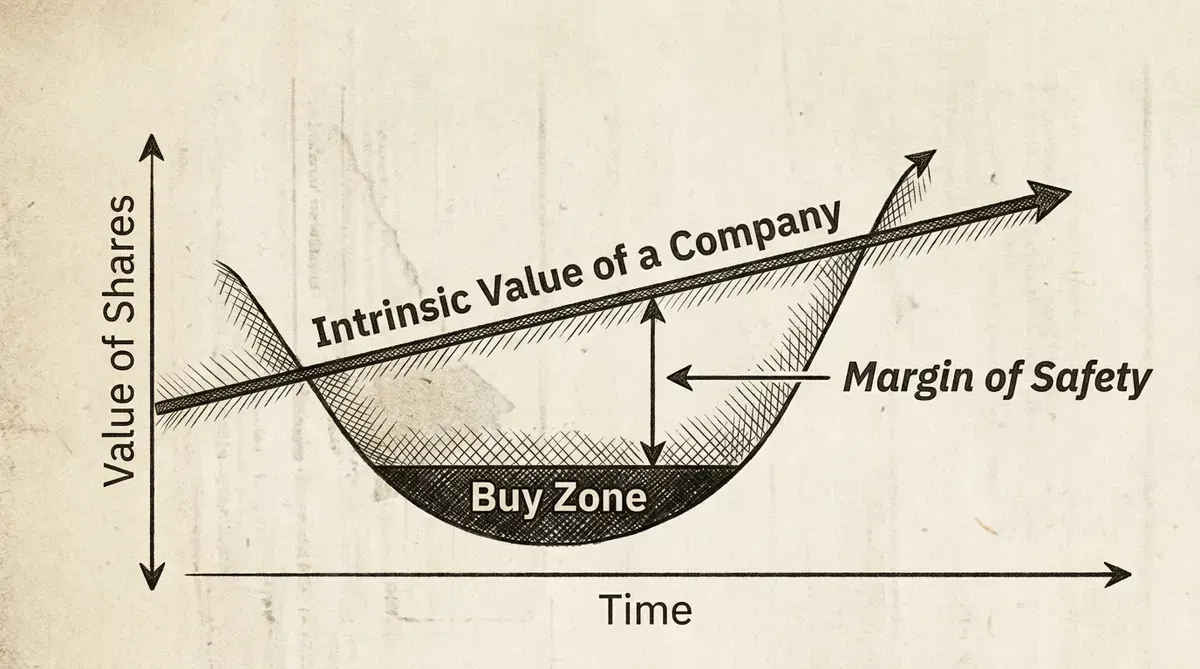
Whatever numbers you use, the governing principle is Graham's margin of safety: never pay a price that requires your analysis to be exactly right. If you estimate a business is worth $100 a share, buying at $95 gives you no protection from your own errors; buying at $60 means you can be substantially wrong and still do fine. The margin of safety is not pessimism — it's humility, priced in.
The temperament game
Here's the paradox: value investing is intellectually simple and emotionally brutal. Bargains only appear when something feels wrong — a scary headline, a bad quarter, a hated industry. You will buy things that everyone around you says are stupid, then wait, sometimes for years, while the market disagrees with you. The strategy's real edge isn't secret math; it's the willingness to look wrong for a while.
That's why the work matters so much. Conviction you borrowed from a pundit evaporates on the first red day. Conviction built from your own reading of the revenue trends, the margins, the debt, and the moat — that survives.
From theory to practice (without a Bloomberg terminal)
The traditional obstacle is workload. Checking margins, debt, cash flow, buybacks, and business quality across even fifty companies can require a substantial amount of source-document review. That often leads investors to rely on a small, familiar list of companies or a few headline metrics.
Relaxfolio removes exactly that obstacle:
- Screen in a sentence. Ask for "low debt companies with high buyback yield" or "profitable companies near 52-week lows" and the whole US market is sifted for you, ranked and tabulated.
- The company view, organised. Type any ticker to review revenue, earnings, and margin trends; key ratios; business segments; and an assessment of business-model strength, growth considerations, and SWOT. These are inputs to a thesis, not a substitute for one.
- Skin-in-the-game signals. Ask "insider buying" to see where executives are spending their own money, or explore what the great investors hold via their public filings.
You still do the thinking — that's the fun part, and the part that builds real conviction. The tool just makes sure your thinking runs on complete information across the whole market, not just the ten stocks you had time for.
A beginner's first value checklist
- Do I understand how this company makes money? (If not — pass. No shame.)
- Does it have a moat I can name in one sentence?
- Are margins strong and stable across years, not just recently?
- Is debt low enough to survive a bad recession?
- Is it genuinely cheap on earnings or free cash flow — with a margin of safety?
- Why is it cheap? Is the market's reason temporary or terminal?
That last question is where fortunes are made and lost — cheap-for-a-temporary-reason is opportunity, cheap-for-a-terminal-reason is a trap. It matters so much that it gets its own article: How to Spot a Value Trap Before It Traps You.
To begin a quality-focused screen, ask Relaxfolio for "low debt companies buying back shares". Explore Relaxfolio →
This article is for educational purposes only and is not investment advice. All investing involves risk, including possible loss of principal.
Put this into practice tonight
Ask Relaxfolio in plain English and get a researched answer in minutes.
Get started