ETF Investing 101: Core, Satellite, and Real Diversification
Why owning more funds does not always mean owning more different stocks.
What ETFs are good at
Exchange-traded funds bundle many stocks (or other assets) into one ticker. For most investors, that solves two practical problems:
- Breadth. One purchase can represent hundreds or thousands of companies.
- Simplicity. Rebalancing a view — US large cap, investment-grade bonds, Japan equities — does not require managing dozens of individual orders.
ETFs are not inherently safer than stocks. They still move with their holdings. But they are an efficient way to express a view — broad market, a sector, a country, or a theme — without building the basket yourself.
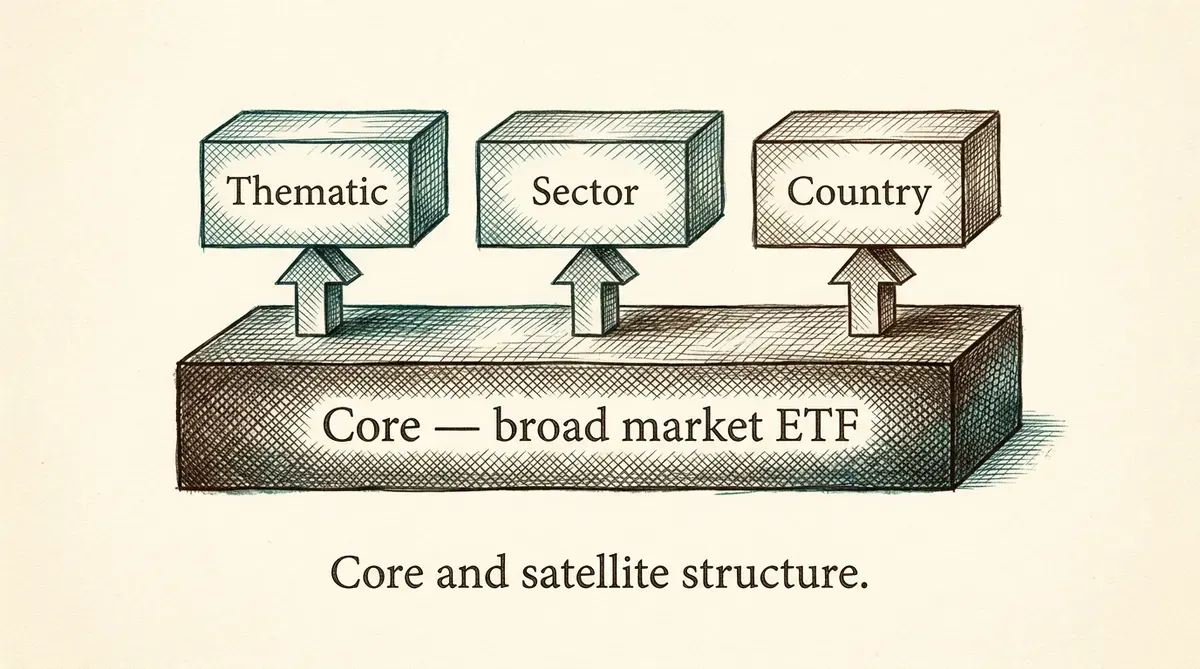
Core and satellite: a common structure
Many ETF portfolios use a core-satellite layout:
- Core: A low-cost, broad fund that anchors the portfolio — total US market, total world, or a balanced mix. This is the "default" exposure.
- Satellites: Smaller positions in targeted funds — semiconductor sector, clean energy theme, Japan country ETF, short-duration bonds — that reflect specific convictions or tilts.
The core keeps diversification cheap and simple. Satellites let you rotate or emphasize ideas without rebuilding everything.
Relaxfolio supports both layers: screen broad market ETFs for the core, then use thematic, sector, or country heatmaps for satellites.
The overlap problem
Here is where ETF investing gets subtle. Fund count is not the same as diversification.
Three ETFs can all hold heavy weightings in the same megacap names. A thematic AI fund, a semiconductor sector ETF, and a large-cap growth fund may each allocate 8–15% to the same chip designer. On your spreadsheet you own three funds; in economic exposure you may be making one concentrated bet three times.
Before adding a satellite, compare top holdings across what you already own and what you are considering. Relaxfolio includes top holdings in ETF screen results so you can spot duplication quickly.
Types of ETF satellites
ETFs are usually grouped by type:
| Type | What it tracks | Example use |
|---|---|---|
| Broad market | A wide index | Core anchor |
| Sector | An industry group | Rotate into leading US sectors |
| Thematic | A business narrative | Express a story (AI, cyber, nuclear) |
| Country / region | A national market | Tilt toward Japan, Europe, emerging markets |
| Bond / income | Fixed income or dividends | Defensive sleeve |
Each type answers a different question. Sector and country ETFs help with rotation — shifting toward what is working. Thematic ETFs help with narrative exposure — linking a business story to a tradable basket.
Diversification vs diworsification
Adding satellites makes sense when each fund adds distinct exposure you understand and can monitor. Adding funds that overlap, charge high fees, or express views you cannot explain is often called diworsification — more complexity without more benefit.
A practical checklist before buying a satellite ETF:
- What does this fund actually hold? Read the top ten names, not just the marketing label.
- Does it overlap my core or other satellites? If yes, size the position accordingly.
- What would prove this view wrong? A theme can be real but already crowded in price.
- Is the fee reasonable for what it does? Broad cores should be cheap; niche themes may cost more.
How Relaxfolio fits in
Ask plain-English questions about ETFs:
- "ETF heatmap" for a grouped view by type and theme
- "Trending ETFs" or "ETF pullbacks" for timing a satellite add
- "Compare AI ETFs" to review holdings side by side
Use the heatmap to see leadership, then drill into holdings before you rebalance.
Next in this series: How to Pick Thematic ETFs Without Hidden Overlap and Sector and Country Rotation with ETFs.
Ask "ETF heatmap" or "Trending ETFs" to review grouped US ETFs with top holdings in the results. Explore Relaxfolio →
This article is for educational purposes only and is not investment advice. All investing involves risk, including possible loss of principal.
Put this into practice tonight
Ask Relaxfolio in plain English and get a researched answer in minutes.
Get started