Reading the Market's Weather: Macro Basics Every Investor Should Know
You don't need an economics degree. You need to know four forces, what they do to your stocks, and where to check them — in ten minutes a day.
Why your great stock pick went down anyway
Every investor eventually lives this: you research a company, everything checks out, you buy — and it drops 15% in a month. The business didn't change. What happened?
The tide went out. Studies consistently attribute a large share of an individual stock's movement not to the company itself but to the overall market and its group. Buy the best boat in the harbor and a falling tide still takes you down with everything else. That tide is what people mean by macro — the economy-wide forces that move all prices at once.
Here's the crucial reframe for beginners: you are not trying to predict the macro (nobody reliably does, including the professionals paid millions to try). You're trying to read the current conditions — like checking the weather before a hike. You don't need to forecast the storm; you need to notice you're in one.
Four forces cover most of what matters.
Force 1: Interest rates — the market's gravity
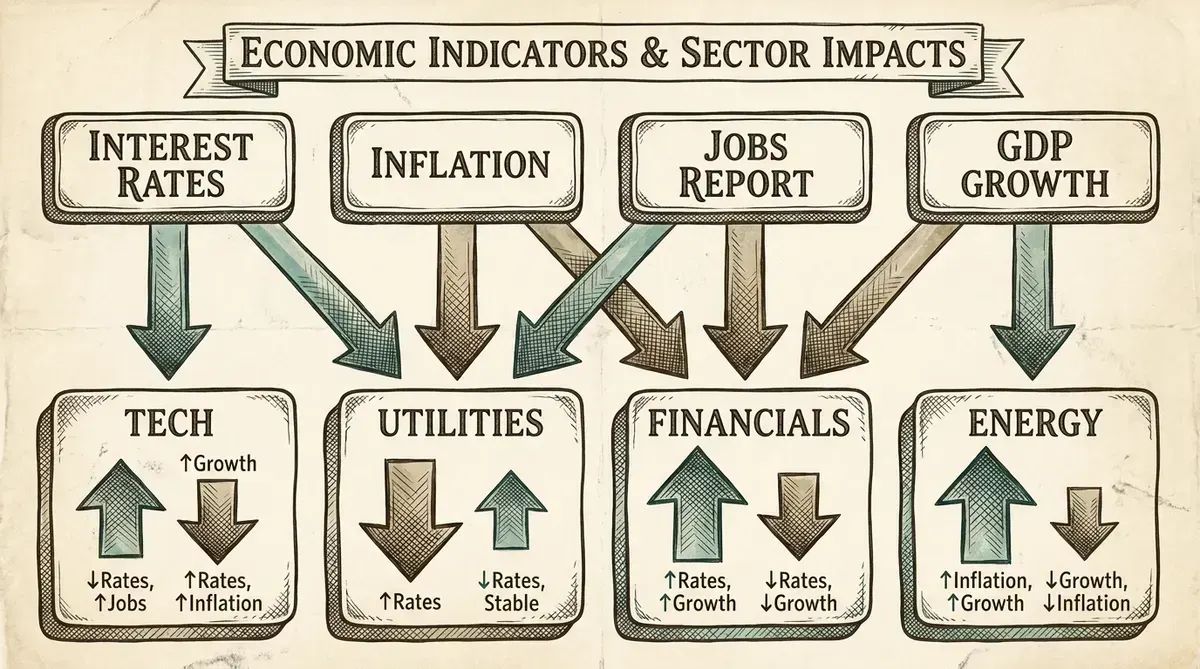
If you learn one macro concept, make it this one. Interest rates are the price of money, set at the short end by the Federal Reserve and by bond markets beyond that. They act on stocks like gravity:
- A stock's price is a claim on future profits. When safe interest rates rise, those future profits are worth less today — because a guaranteed 5% in bonds competes with your risky stock returns. Rising rates pull valuations down, most brutally on growth stocks whose profits sit far in the future.
- Rates also work on the real economy — mortgages, car loans, corporate borrowing — throttling or fueling growth with a lag.
This is why markets hang on every Federal Reserve meeting, and why inflation reports move stocks that have nothing to do with consumer prices: inflation is what forces the Fed's hand. Hot inflation → higher rates → gravity increases. Cooling inflation → rate cuts possible → gravity eases. Once you internalize this one chain — inflation → Fed → rates → valuations — a startling amount of confusing market news becomes legible.
Force 2: The economic cycle — expansion and contraction
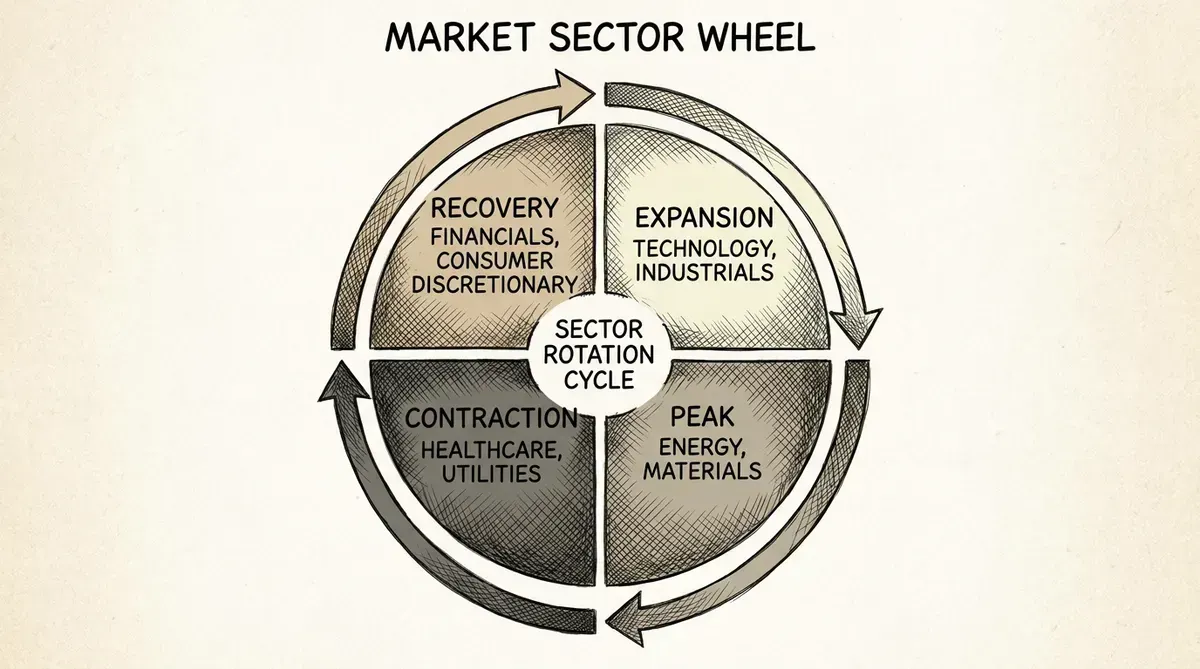
Economies breathe: expansion, peak, contraction, recovery, repeat. Corporate profits — the thing stocks ultimately price — swell and shrink with that breath. A few practical implications:
- The market moves before the economy. Stocks typically fall before recessions are declared and bottom while headlines are at their most apocalyptic. Trading on today's economic headlines means trading on what markets priced in months ago.
- The cycle picks winners by group. Early recoveries favor economically-sensitive sectors (industrials, consumer discretionary, small caps); late cycles and downturns favor defensives (healthcare, utilities, staples — things people buy regardless). This rotation is visible, watchable, and one of the most useful patterns in investing.
- Employment and growth data are the cycle's vital signs — worth glancing at monthly, not obsessing over daily.
Force 3: Risk appetite — the market's mood
Beyond rates and cycles, markets swing between two collective moods, and you can read today's mood directly from what's leading:
- Risk-on: money flows toward growth stocks, small caps, speculative themes. New highs broaden across many groups.
- Risk-off: money hides in defensives, mega-caps, and cash. Rallies are narrow; former leaders get sold.
Why care? Because the same action has different odds in different moods. Buying a speculative breakout works in risk-on tape and bleeds you in risk-off tape. The single most professional habit a retail investor can copy is checking the mood before acting: what's leading — offense or defense?
Force 4: Themes and mega-forces — the decade-long tides
Underneath the cycles run slower, larger currents: artificial intelligence buildouts, energy transitions, demographic shifts, deglobalization and reshoring, new classes of medicine. These mega-forces create multi-year themes that can pull their member stocks up through ordinary market weather — and their absence explains why parts of the market stagnate for a decade while others compound relentlessly.
For a stock picker, this is often the most actionable macro layer: a mega-force can affect a network of businesses over an extended period. A theme structure helps translate that force into a research universe by linking companies through shared technology, demand, or value-chain relationships rather than limiting the analysis to one sector. The practical question each month is not only "what is the GDP forecast?" but also "which themes are showing participation, and is that participation broadening or narrowing?"
The ten-minute weather check
Here's the entire discipline, sized for a real life:
- Rates and inflation direction — rising, falling, or paused? (That's the gravity setting.)
- Market trend — are the major indexes above their long-term moving averages? (That's the tide.)
- What's leading — offense or defense, and which themes show participation across related companies? (That's the mood and the current.)
- Anything scheduled — Fed meeting, big inflation print, earnings season? (That's the forecast.)
Assembling this picture can require moving between sources and deciding which measures deserve attention. Relaxfolio brings market commentary and direct research questions into the same workflow: "which themes are strongest this month?", "how are rate-sensitive businesses behaving?", and "which companies are connected to this macro theme?" The aim is to make the relationships among market conditions, economic drivers, and connected businesses easier to review.
The two macro mistakes to avoid
Having handed you the weather kit, two warnings about overusing it:
- Don't become a macro-paralytic. There is always a credible-sounding reason to sell everything and hide. Investors who act on every macro scare reliably underperform those who stay invested through them. Macro context should tilt your aggressiveness and your group choices — not flip you all-in and all-out.
- Don't fight the tape with a forecast. If your macro theory says stocks must fall and the market keeps making new highs, the market is voting with trillions and your theory is voting with a feeling. Respect the vote. Check the weather; don't argue with it.
That's the whole skill: know the four forces, check them in minutes, tilt accordingly, and spend your real energy where a retail investor actually has an edge — knowing individual businesses and setups better than the crowd. For putting it all together, start with How the US Stock Market Really Works and Choosing Your Investing Style.
Use Relaxfolio's market commentary to place current conditions in a broader framework. Explore Relaxfolio →
This article is for educational purposes only and is not investment advice. All investing involves risk, including possible loss of principal.
Put this into practice tonight
Ask Relaxfolio in plain English and get a researched answer in minutes.
Get started