Choosing Your Investing Style: Momentum, Value, or Swing?
The best strategy isn't the one with the highest returns on paper. It's the one you'll actually stick to. Here's how to find yours.
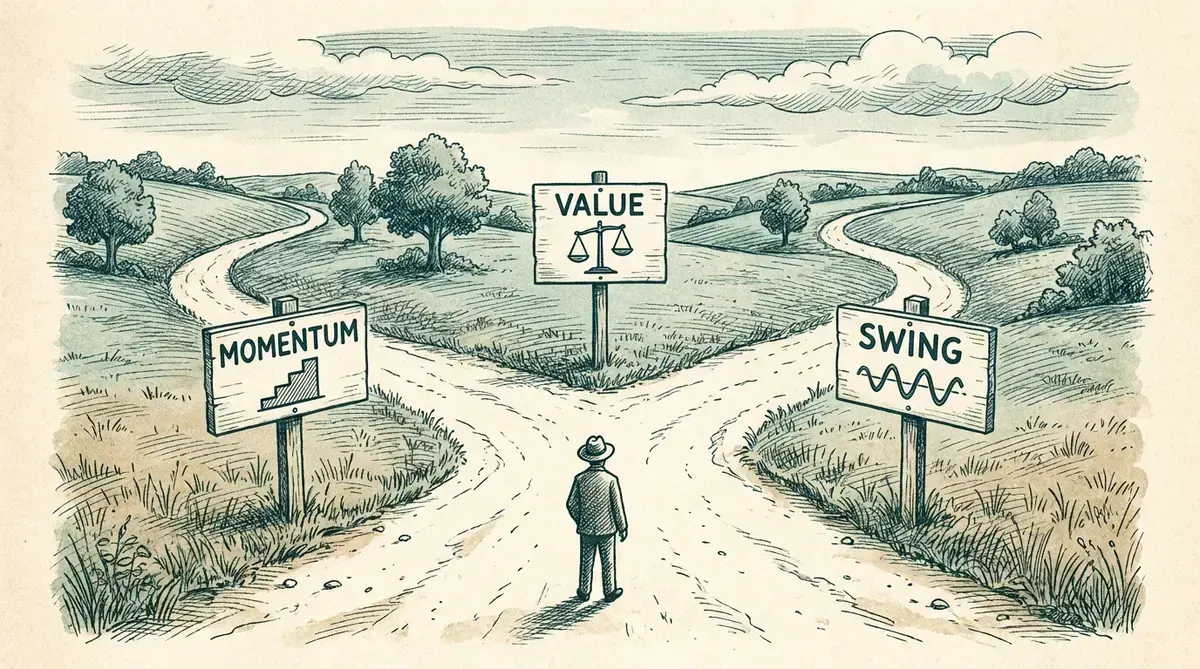
The question nobody asks first
Most people begin investing by asking "what should I buy?" The better first question is "what kind of investor am I?" — because the market rewards many different approaches, but it punishes one thing ruthlessly: strategy-hopping. The investor who buys momentum stocks, panics like a value investor, and sells on a swing trader's timeframe combines the weaknesses of every style with the strengths of none.
Every legitimate style is a package deal: a source of returns, a set of habits, a time commitment, and — this is the part people skip — a specific kind of emotional pain you must be able to tolerate. Choosing well means matching that package to your actual life and temperament, not to whoever posted the best screenshot this week.
Let's meet the three main styles honestly — edge, effort, and pain included.
Momentum: buy strength, ride trends
The idea. The market's biggest winners trend for months as their success gets gradually recognized. Momentum investors buy stocks already proving themselves — breakouts, new uptrends, leading themes — hold while the trend is healthy, and exit when it breaks. (Full introduction: Momentum Investing 101.)
The commitment. Regular but light: a short evening check-in most days, since trends need monitoring and exits matter as much as entries. Holding periods run weeks to many months.
The pain you must tolerate. Buying stocks near their highs (feels reckless, is statistically sound), taking many small losses when trends fail, and watching a former winner get sold per your rules — then bounce without you. Momentum requires acting against instinct on schedule.
You'll probably love it if you like clear rules, visible feedback, and being where the action is. You'll hate it if you can't take small losses without brooding, or "buying high" keeps you up at night.
Value: buy businesses for less than they're worth
The idea. Prices swing far more than business reality; sometimes quality companies go on sale — a bad quarter, a hated industry, a market panic. Value investors research businesses deeply, buy below their estimate of worth with a margin of safety, and wait for reality to be recognized. (Full introduction: Value Investing for Beginners.)
The commitment. Lumpy and deep: hours of research per candidate, then long stretches of deliberate inactivity. Holding periods run years. Weekly check-ins suffice.
The pain you must tolerate. Looking wrong for a long time. Your bargain will usually get cheaper after you buy; your friends' momentum stocks will lap you in bull markets; the payoff arrives in occasional lumps after long droughts. Value requires conviction that survives being publicly unfashionable.
You'll probably love it if you enjoy understanding businesses, distrust crowds, and find patience satisfying. You'll hate it if you need frequent wins to stay engaged, or you check prices hourly.
Swing trading: capture the clean middle of moves
The idea. Stock moves have a messy start, a clean middle, and a chaotic end. Swing traders take defined-risk positions in that middle — days to weeks — using repeatable setups (pullbacks, coils, channels) with pre-planned stops and targets. Win rates near 50% are fine because winners are sized to pay 2–3× what losers cost. (Full introduction: Swing Trading 101.)
The commitment. The most routine-driven of the three: a focused 20–30 minutes most evenings — scan, plan, manage, journal. Not optional, but designed to fit around a day job.
The pain you must tolerate. Constant small losses (they're the business model), strict rule-following when emotions scream otherwise, and boredom discipline — not trading when nothing qualifies. Swing trading requires treating yourself like an employee of your own process.
You'll probably love it if you like craft, measurable improvement, and fast feedback loops. You'll hate it if you can't follow your own rules under stress — the style has no forgiveness built in.
The honest fourth option (and the smart hybrid)
Index-first investing — automatically buying broad market ETFs and letting decades do the work — is the correct foundation for almost everyone, requires nearly zero time, and outperforms most active efforts. If reading the three profiles above triggered no excitement, that's a valid answer: index, live your life.
But if the market genuinely interests you, the smart structure isn't either/or: an indexed core with an active satellite — most of your capital compounding passively, a deliberate slice (say 10–25%) run in the style that fits you. The core protects your future from your learning curve; the satellite makes you an investor rather than a bystander. Many of the best retail investors also blend styles' tools: value investors using trend signals for timing, momentum investors reading fundamentals to size conviction. The styles are lenses, not religions.

A self-test, then a field test
Score yourself honestly:
- Time: 30 minutes most evenings (momentum/swing) — or occasional deep weekends (value)?
- Loss style: many small stings (momentum/swing) — or long unrealized drawdowns on positions you believe in (value)?
- Patience horizon: does holding for years sound peaceful (value) or unbearable (swing)?
- Decision style: rules and triggers (momentum/swing) — or theses and judgment (value)?
- When a stock you own drops 15% on no news, your instinct is: verify the thesis and consider buying more (value) — or respect the tape and cut it (momentum/swing)?
Then — and this is where most people's education stalls for years — test your answer against reality without betting real money on it. This is exactly what Relaxfolio makes easy: it speaks every style. Run "trending stocks" and "breakout stocks" for a few weeks and see if watching trends excites or exhausts you. Run "low debt companies buying back shares" and read a few company dossiers to see if business analysis absorbs you. Run "pullbacks" nightly and see if the routine feels like craft or chore. Track your hypothetical decisions in a journal. Six weeks of observation will tell you more about your investing temperament than six months of reading — at a cost of exactly zero mistakes.
Whichever style fits, you'll find the corresponding playbook in our guide library — and a research engine built to run it. The market doesn't care which door you choose. It only cares that you stop switching doors.
Use the signature queries for each approach — "trending stocks", "insider buying", and "pullbacks" — to compare the research workflows. Explore Relaxfolio →
This article is for educational purposes only and is not investment advice. All investing involves risk, including possible loss of principal.
Put this into practice tonight
Ask Relaxfolio in plain English and get a researched answer in minutes.
Get started